Little effort, big payoff (?): In the age of AI, what sounds good often leads to pointlessly long walls of text or an “ocean of sameness”. At the same time, we avoid the very effort that made the work valuable in the first place. How do we tell smart from thoughtless AI use?
The journey often matters more than the destination.
Some days ago, my daughter excitedly pressed a piece of paper into my hand. Proudly, she explained that she had drawn a house for me.
I was grateful for the gift, but even moreso for the explanation: even the most benevolent viewer (me) struggled to make out a building without the artist's help.
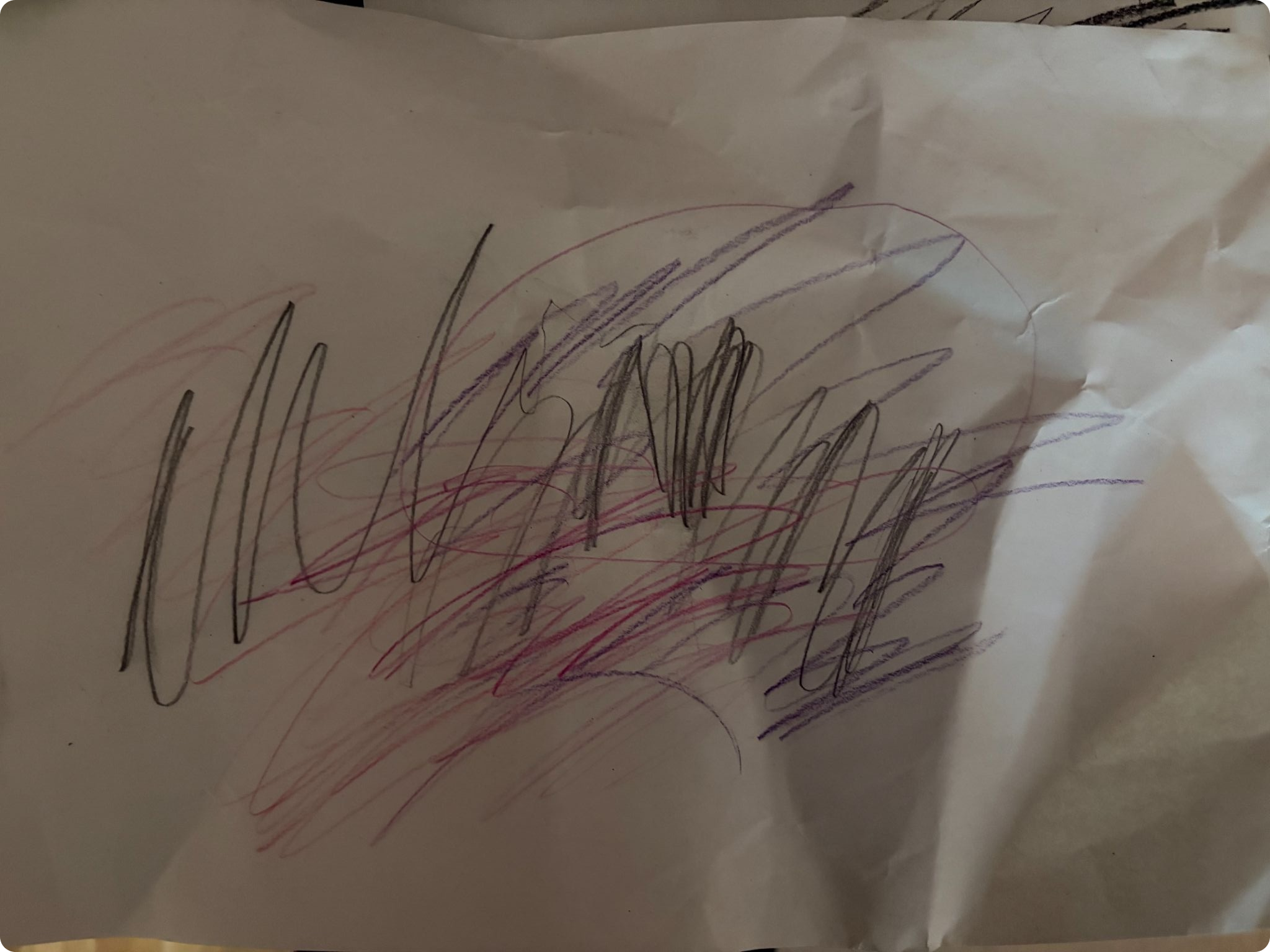
Line work and spatial depth still leave room for improvement, but this picture is so vauable that I hung it on my wall. My daughter's work may not (as of now!) show technical genius, but it is full of effort, growth, intention and love.
Often the path to a result is far more valuable than the result itself, and sometimes the result is completely worthless without the path that led to it. (Yes, this is a metaphor for AI.)
Unfortunately, these two things, result and path, aren't always easy to tell apart.
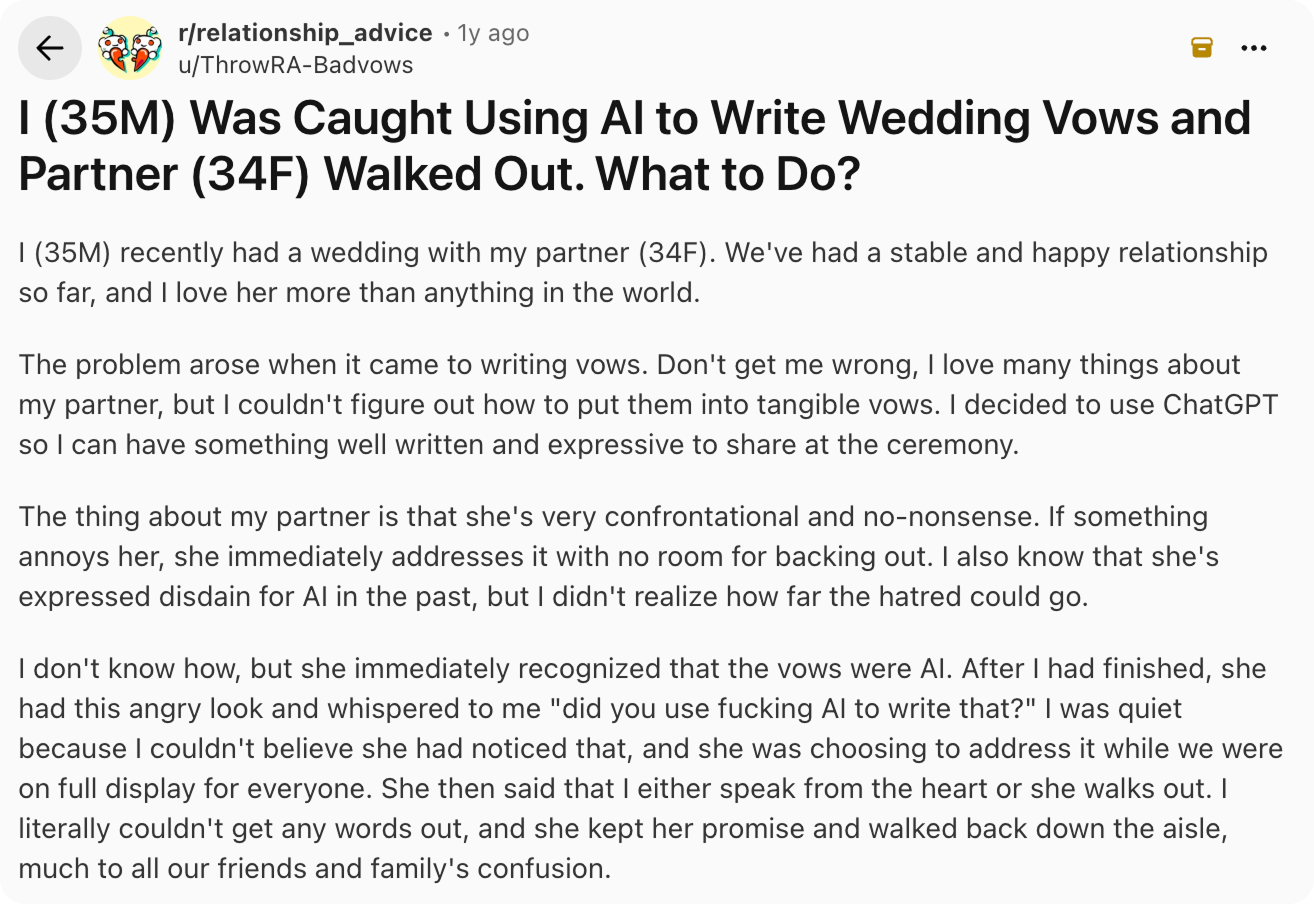
Sometimes it's tragic when one is mistaken for the other, as in this case, where a bride left the groom standing at the altar while he read his wedding vows: polished but unmistakably AI-generated:
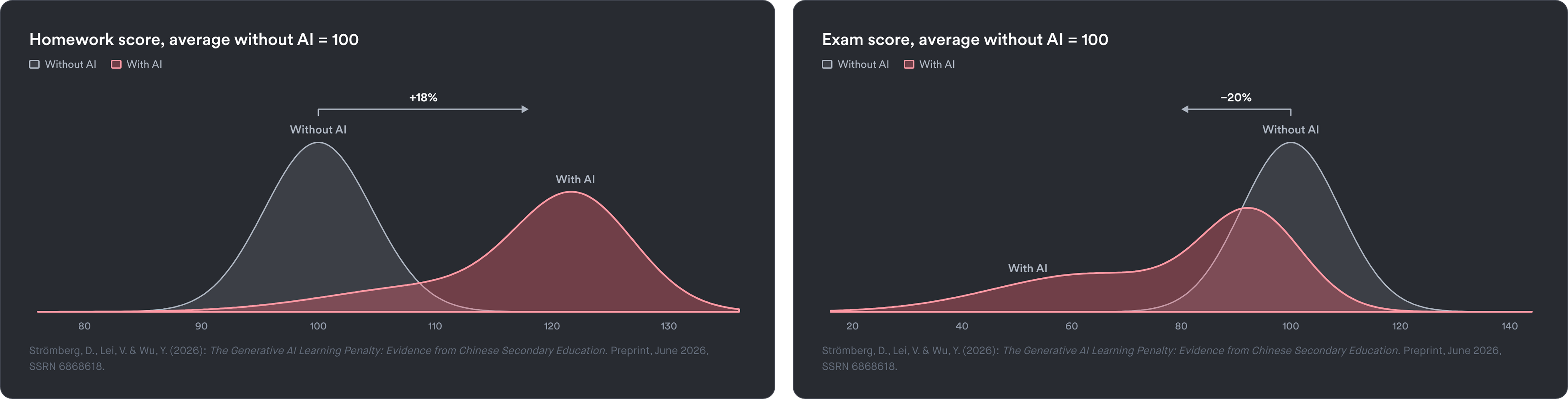
Sometimes it's entirely predictable, as with pupils and students who want to avoid work (a time-honored tradition). They let AI do their homework, and in doing so they invert another principle that held for millennia: those who turn in better homework tend to write better exams.
Now it's the exact opposite: the more AI is used, the better the homework, and the worse the exams once AI is no longer available (source).
And very often, especially in professional contexts, it's a mix of incentives and lack of reflection that leads us to hand work to AI that becomes worthless without our own effort.
The Point of Reading
Early on, Jeff Bezos introduced the following rule at Amazon: PowerPoint was banned in meetings with his executives. Instead, the person who would otherwise have walked everyone through slides had to prepare a memo of up to six pages. In a one-hour meeting, the first half was spent reading the memo: "The only sounds in the room came from the pens used to write notes in the margins."
Bezos's logic was that the ability to write six pages of clear prose requires a high degree of clear thinking and effort, unlike a string of bullet points:
Full sentences are harder to write. They have verbs. The paragraphs have topic sentences. It is impossible to write a six-page, logically structured memo without being able to think clearly.
That assumption is now history.
Today, a six-page, logically structured memo is easy to create with a short prompt. And because in a large company like Amazon rules survive while the intention behind them often doesn’t, to no one’s surprise:
Thirty minutes into a review meeting at Amazon, a product manager opened the discussion on a six-page document. Two minutes later, it was obvious to everyone in the room that he had just read the document for the first time.
Like many other organizations, Amazon suffers from workslop: content generated at the push of a button, which requires little effort or experience but meets all the formal requirements of a work product.
My impression is that this problem is escalating in many companies. Increasingly, people tell me frustrated stories about their colleagues sharing pages-long AI-generated status updates or reports.
When pressed about unclear passages, these colleagues typically reply: "That was written by AI, best double-check it." Or simply: "Oh, that's AI, you can ignore that part."
Anyone who uses AI this thoughtlessly has created two problems at once:
Problem one: They externalize their own work. Just like the Amazon manager, they pass what was once their job on to their colleagues.
Whether a passage deserves to be ignored, the reader can only decide after reading it, by which point their eyes have glazed over from pages of workslop. And why should I, as the reader, check something because it was written by AI? Didn’t the rule used to be that an author checks their text before sharing it?
Problem two: They skip an enormously important part of the work. Like a weightlifter who comes to the gym with a forklift, they have misunderstood the assignment.

Yes, there are words here, arranged in an order that makes them look like a market analysis. But the knowledge of the market that the author used to build along the way has barely come into being: text is only ever the tip of the iceberg of knowledge and understanding that normally lie beneath it.
At work, this behavior is frustrating.
In other contexts, it's sad:
Former Yahoo CEO Marissa Mayer has a 10-year-old daughter. The daughter's teacher asked Mayer to write down three things that made her daughter unique. The task overwhelmed Mayer so much that she preferred to ask her personal AI assistant Dazzle: "And it came back with: your daughter is empathetic, creative and loves animals." Mayer thought the answer was perfect.
A small plot twist: Mayer's own startup is the creator of Dazzle, so we should take her story with a grain of salt. But the mere idea that a mother is so overwhelmed by the task "name three things that make your daughter unique" that she has someone else, human or machine, do it for her is enormously bleak.
Undelivered Deliverables
When people misunderstand why they do something, it can take bizarre forms.
During World War II, Japanese and American forces landed on islands in the South Pacific whose inhabitants, until then, had had little contact with the outside world. The soldiers arrived with technology from another world, aircraft and enormous motorized ships, and left behind tons of food, clothing, medicine and weapons.
Many years after the war ended, religious movements on the islands still hoped to repeat these miracles through ritual. They built control towers and carved headsets, lit torches along self-made runways and marched with bamboo bayonets.
From the Melanesians' point of view, all the conditions for new aircraft to land had been met. But they were disappointed: no further cargo ever arrived.
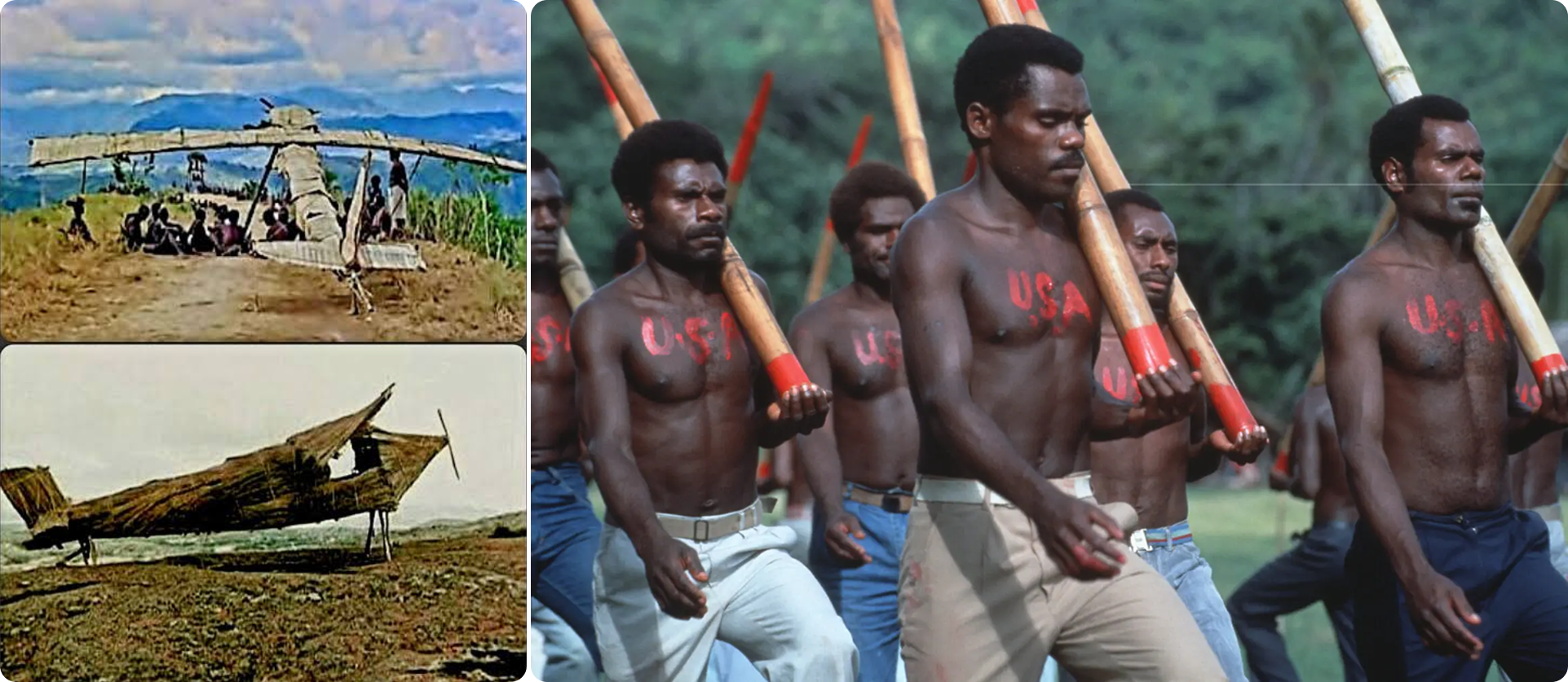
These so-called cargo cults have since become a metaphor for activities that once had a purpose, no longer serve it, but persist in form, often without the people involved realizing it.
This has always been a problem for organizations, and sometimes for individuals too.
The mother asked to explain what makes her daughter unique, the groom who is supposed to say why he loves his bride, and the Amazon manager who is supposed to work on an idea hard enough to describe it in six pages: they are all following a cargo cult when they believe they can outsource their work to a machine.
But whether we and the organizations we work in fall victim to a cargo cult is up to us.
The more the pure result matters, the more sense it makes to use AI; the more the path to it matters, the less. Jeff Bezos was interested in the content of the memos, but above all in making sure that people at his company thought carefully.
At the same time, the result of our work, or of our prompt, has to treat other people's time with respect. It cannot be acceptable to generate maximally long texts with minimal effort and leave them for our colleagues to check.
Culture Eats Good Intentions for Breakfast
We won't get workslop under control just because a few people in the company use AI intentionally, but via company culture. The unicorn startup Clay.com has internal rules that I recommend to any organization that wants to use AI wisely. Here is a link to the full text, because it is worth your time.
Some companies in my own circle have since adopted similar rules, including firms that make their money developing AI themselves. There, in my impression, the problem is especially large, because employees use AI more heavily.
At the same time, awareness of the problem is growing fastest there, because people think more carefully about effective use than in places where the Copilot rollout is still being debated.
Microsoft Executive Vice President Ryan Roslansky, for example, described his experience with workslop like this:
Someone sent me what was clearly an AI generated doc. I read it, realized it was all AI, had my AI summarize it and ended up with nothing that brought new thinking to the idea... This is a doom loop. If we're not careful, we'll end up (...) in an ocean of samenesse...
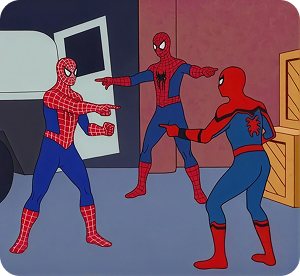
At best, we don't use AI as a shortcut that leads us into a sea of sameness, but in a way that makes our ambitions bigger: so that we achieve things that were previously impossible and learn things that were previously out of reach.
Because despite all the hype, the potential and impact of AI are still underrated.
The technology carries far greater risks than workslop, but also the chance of unimaginable progress. We should just remember that sometimes, on the way there, we have already arrived.

